Search

Saturday, August 3, 2019

Buckeye Butterflies: Color and Complexity

I step away from my computer at the Lawrence Hall of Science, and cross the parking lot to the open hillside, overlooking the bay. The grasses are crackly, bleached, and bristling with sticky burrs and seeds that attach to my socks and leg hairs. I stand blinking in the bright. A pair of butterflies fly up from the grass, circling each other, and disappear over the oaks. Another butterfly crosses in front of me and lands. It is soft brown, with pale shades of orange and yellow. It has six striking black circles on its wings. A common buckeye. I stand watching and spot many more. Whenever two encounter each other they spiral off in a chase.


Some have significant pieces of their wings missing.


Many sources say that the males are territorial: that the chases I saw were males claiming their patch of the hill. If so, how do they determine which one is the winner? How far away does the loser go? On the other hand, James Scott writes in The Butterflies of North America: A Natural History and Field Guide, "Although the male behavior of chasing passing objects looks pugnacious, males are not truly territorial but merely looking for females." If this is the case, I wonder what purpose the furious, spiraling flight serves. A test of fitness before a mate is accepted?

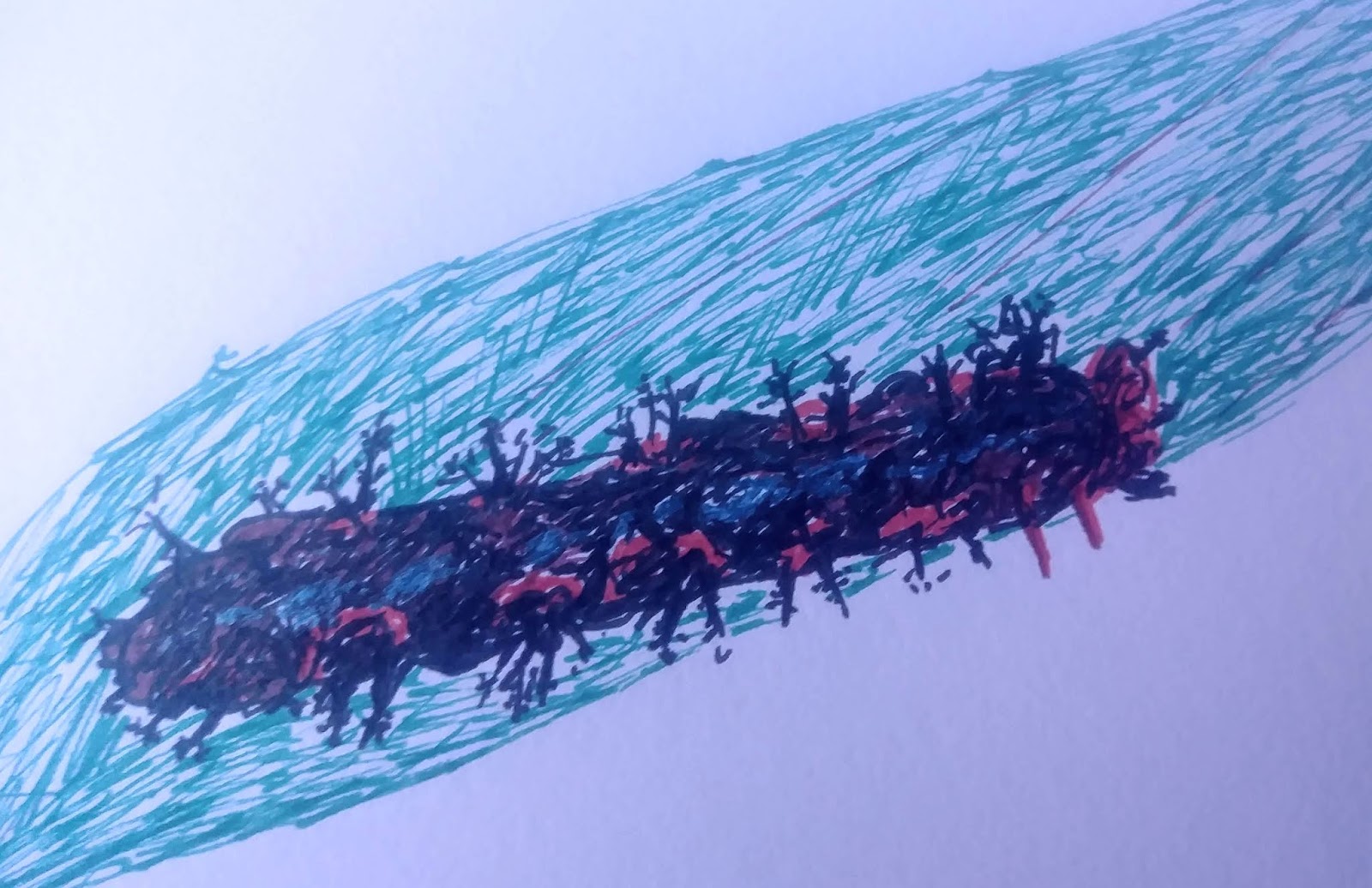
The larva are bristly black caterpillars with orange bumps. The bumps may serve as a warning to potential predators. One of the larvae's primary foods is the narrowleaf plantain. This plant has a molecule that inhibits growth in predators such as wasps, and and birds, though it increases growth in the caterpillars. Buckeye larvae that eat more plantain are less likely to be eaten by predators. Apparently, this protection does not extend to the adult butterflies, which are frequently eaten by birds. The missing chunks I noticed from their wings were probably from beak attacks.


In the bay area, buckeye butterflies can hatch at any time of year, but most hatch from mid-summer to early fall.  They evolved from tropical species and cannot withstand severe cold no matter what life stage they are in. They were nearly wiped out in the bay area during an extremely cold week in 1990, then gradually recolonized our area. The appearance of the common buckeye vary depending on what time of year they hatch. Those born in winter or early spring are much smaller. Those born from late August through October have a purplish or brick-red underside, while those that hatch at other times are much paler. The genes controlling color in the buckeye are complex-- coding both for pigments as well as nanostructures that refract light and create iridescence. No one knows exactly how changing hours of daylight and temperature affect the expression of these genes.

As I watch the buckeyes, a speck of blue flickers on and off: the acmon blue has bright blue upper wings, but pale grey underwings. It is not much bigger than my thumb nail.


The field crescent has a similar color pallete as the buckeye, but in a stained-glass checkerboard.


At first glance, a grassy hillside in bay area summer appears fairly simple and monochromatic, but a world of color and complexity is revealed by the butterflies there. The orange bumps on a buckeye larvae hint at struggles and evolution among buckeyes, birds, ants, and plants: a contest at the scale of molecules. The changing shades of the buckeye wings mark the slow shift of the seasons, and hint at connections between the orbit of our planet and the genes in the butterflies' cells.

LINKS
Field Guide to Butterflies of the San Francisco Bay and Sacramento Valley Region (fabulous field guide and the source of much of the information in this post)
Art Shapiro's Butterfly Site (online butterfly guide from UC Davis)
       Buckeye page
The Lawrence Hall of Science (butterfly habitat outside, science museum- and my desk- inside)
The Butterflies of North America: A Natural History and Field Guide

Sunday, July 21, 2019

Leopard sharks in summer shallows

I feel a craving for nature—even just a touch of it, so I bike out for a little walk at the McLaughlin Eastshore State Seashore by the Berkeley marina. In February, I took this same walk. Then, rain showers swept over me and away into the hills. The willows seemed soft. There were small pools near the trail, fringed in green. A double rainbow burst into the dark sky.


A cooper's hawk sat on a chainlink fence fluffing raindrops off its feathers.


I am remembering the feeling of that February walk as I bike over. But now it's July. The trail is all hard dry grasses and the spiny husks of thistles. There are no birds. I don't even see any butterflies or bumblebees. It feels like the city and the freeway are looming close. I give up and wander over to the shore of the bay. I sit on the big black rocks, carted in in the 1930's when the marina was built. I sit watching the water, thinking about how summer is my least favorite season here.

A few minutes later something large splashes a few feet from shore. What was that? A few minutes later, another splash. This time I catch a glimpse of something dark and fleshy in the splash. It looks like a part of something larger. Could it be a bat ray? A leopard shark? The next glimpse I catch shows a dorsal fin. I think it was a leopard shark!


Leopard sharks are the most common shark in the bay. They are usually about a meter to a meter and a half long. They have tiny teeth, and cruise in shallow water, sucking worms, crabs, clams, shrimp and small fish out of the muddy bottom. Summer and late spring may be be the best times to spot leopard sharks in the bay. They prefer warm water and at least some migrate out of the bay during the colder months. Also, they give live birth in shallow areas (especially eel grass beds) in late spring and mate, also in shallows, in early summer.


Almost none of the seasonal events I look forward to—chanterelles bursting forth after winter storms; mixed flocks of warblers and other song birds migrating through in spring and fall; bugling elk at Tomales Bay in September; carpets of checkermallow, poppies, and vetch in Tilden in April—happen in summer. The glimpse I caught of the leopard shark was a reminder that even this dry time has its treasures.

LINKS:
Leopard Shark information from the Monterey Bay Aquarium
McLaughlin Eastshore State Seashore


Sunday, June 2, 2019

The Two Worlds of the Odonata (Dragonflies and Damselflies)

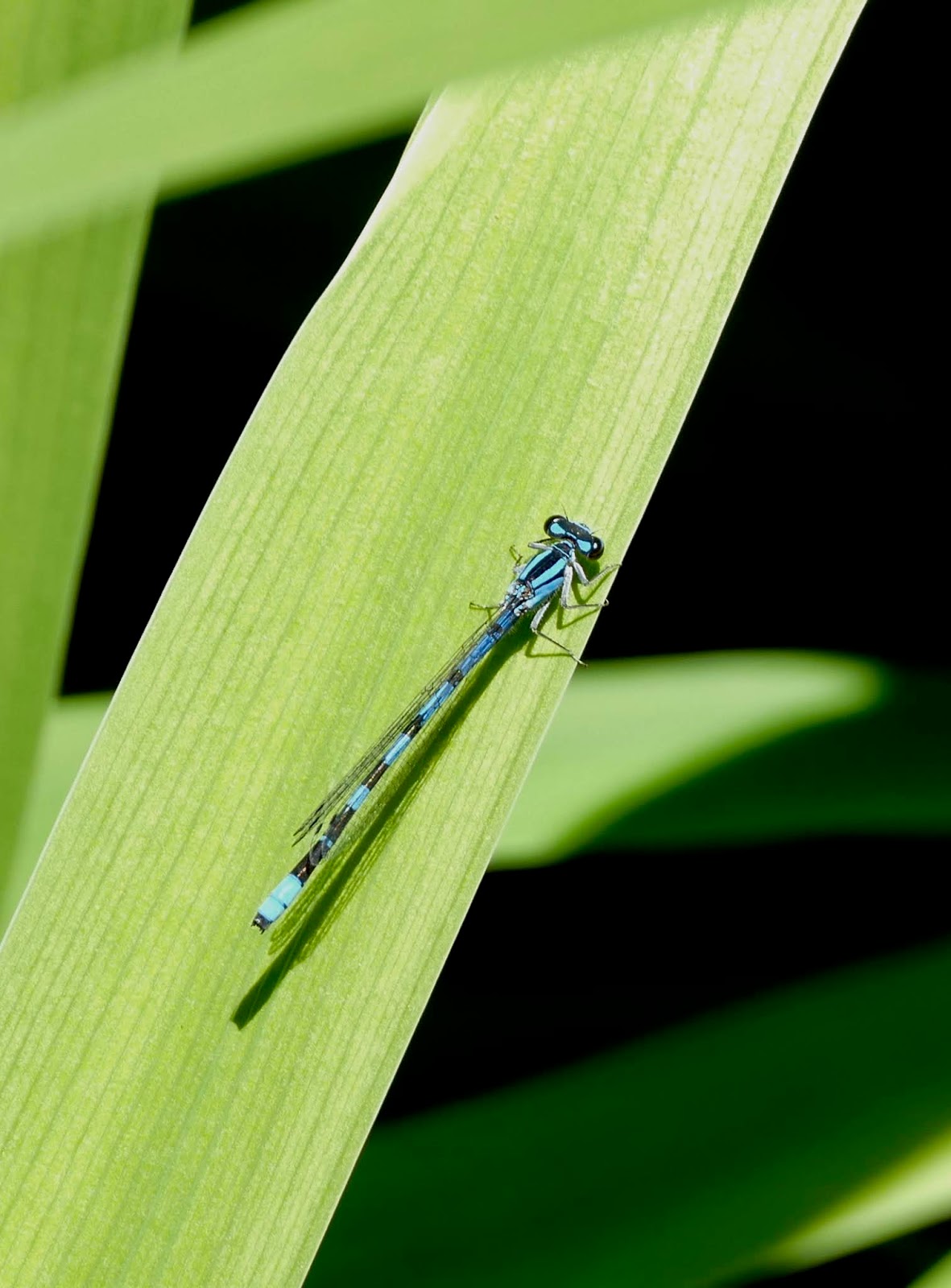
The pond is dotted with water lilies and ringed by purple iris. A thin twitch of bright blue catches my peripheral vision. Now it's motionless, a dashed line, blue and black, balanced on an iris leaf. Wings are folded along its back and the head is wide, with eyes on the sides. It's a common bluet, or common blue damselfly.


Now that my eyes are tuned to the small insects, I start to see more. A thicker, red insect lands on a small sign in the pond. It holds its wings out from its sides, rather than folding them down its back.  The wings look like fine mesh. This is a cardinal meadowhawk, a type of dragonfly.


Its match, but in blue rather than red, lands on a leaf. It's a blue dasher, or blue darter.


Dragonflies and damselflies comprise the order Odonata, and have been around for about 350 million years. Dragonflies have evolved incredible agility in flight, with the ability to fly backward or upside down, and to make sudden changes of direction and speed. Odonata have also evolved advanced vision. They can see 360° around them, and see colors in much greater detail than we humans can. Humans have three kinds of opsins in our eyes that detect green, red and blue; the colors we see are mixes of different amounts of these three colors. Dragonflies have eleven kinds of opsins—what does the world look like to them?! They can even see ultraviolet light. They also have three small eyes called ocelli that are specialized for detecting extremely fast movements.

Odonata hatch from eggs laid in or near water. They then live most of their lives underwater as nymphs, which look kind of like narrow beetles. As nymphs, they hunt other aquatic insects, as well as tadpoles, and even small fish. Dragonfly nymphs seem like science fiction creatures: they have mouthparts like a lower jaw that can shoot out to snare their prey, and they can blast water out of their anus for a quick burst of movement.


A nymph may live eight or nine months, or for some species several years, before it transforms into an adult dragonfly or damselfly, usually emerging in the spring or early summer. The zipping lines of blue, red, brown, or green above ponds and streams is a sign of summer. As adults, dragonflies and damselflies hunt bugs in the air, often above the same pond or stream where they lives as nymphs.

I like imagining that experience. A dragonfly spends most of its life immersed in water, the surface a barrier it might never breach. The water is its world, its universe. Then, a change, a transformation, and it leaves the water. It takes to the air. What would it feel like to look down on your old world, see its surface, but never enter that world again?

LINKS:
UC Botanical Garden where I saw these Odonata
Odonata Central species accounts:
       Common bluet
       Blue dasher
       Cardinal meadowhawk
Science Magazine article about dragonfly flight
Western Odonata facebook group

Wednesday, May 15, 2019

Spring bird song

A liquid, twisting bird song sails out from the willows. I stop walking, search the treetops and see no birds. The song burbles out again, a string of curling, clear phrases. I know it's a black-headed grosbeak because it sounds, just as it's often described, like a robin that has taken voice lessons. But I can't see it. A week later, on the same trail near Jewel Pond in Tilden Park, I hear the song again, and this time I see a few of the birds—robin-orange chests, black faces, chunky (gros!) beaks. They stay mostly tucked among the branches but I get a few not-quite-focused photos.


Male black-headed grosbeaks arrive to the Bay Area from their winter habitat in Mexico a few days before females do. At this point, the males sing as part of their competition to stake out territory. Apparently, if the hierarchy is not settled by singing, they will also attack each other in the air. As the females arrive, males sing to attract mates. Once pairs are established, females sing as well, with both males' and females' songs working to alert other black-headed grosbeaks to stay out of their territory. Perhaps their singing also functions to strengthen their bond to each other?


It feels contradictory—the song's utilitarian (even aggressive at times) functions next to its ornate, extravagant beauty. There is disagreement among evolutionary biologists about how beauty evolves. Some argue that it is always a measure of fitness: a beautiful trait, such as an elaborate song, is  an indicator that helps one individual (usually the female) choose the mate that is likely to have genes for strength, health, survival. Others argue that mate selection may favor beautiful traits that have nothing to do with practical advantages: a species' brain evolves to prefer some quality, perhaps somewhat incidentally and for a reason unrelated to mating at all, then this preference bleeds into mate selection, and over time this leads to more and more extreme forms of that trait.

In our springtime forests and fields, blackheaded grosbeaks are far from the only bird you will hear singing. The song I hear most is the song sparrow: tik tik tik tsweeeeeeee chirry chirrchir The first three simple tik notes are like a warm up to its virtuoso trills. It has the endearing habit of posing at the top of a bush and ignoring nearby humans as it sings.


Our brains  as well have evolved to appreciate beauty. And it seems that we and the song birds have evolved similar aesthetics. The songs meant to woo grosbeaks or sparrows touch me and my breath catches in my throat.

LINKS:
New York Times article about the evolution of beauty
Black-headed grosbeak information from Cornell Lab of Ornithology
Song sparrow information from Cornell Lab of Ornithology
Tilden Regional Park

Saturday, April 27, 2019

Wildflowers in the shade

The redwoods rise all around us, rough-textured towers. We walk in their thick shade. Just off the path, a curl of purple catches my eye. We step closer and see an orchid, a single bloom on a slim stalk, with just one leaf hugging the ground. Looking closer, we see intricate white and yellow patterns on its large lower petal. Then we notice a little trail of the same flowers under the trees, about eight or ten all together.


The western fairy-slipper lives in shady forests and bogs. Its bright color and sweet smell attracts pollinators—especially newly hatched queen bumblebees who don't realize that it offers no nectar.

Spring is wildflower season. The showiest blooms, called superblooms, happen in sunny grasslands where poppies, lupines and others paint whole hillsides, especially if the rains have been good. These are most dramatic in Central and Southern California where it is drier. In Northern California, there is enough rain that introduced European grasses take over many grasslands, leaving less room for native wildflowers. This spring, I have been appreciating a less dramatic class of wildflowers: those that bloom in deep shade in the forest, such as the western fairy-slipper.

In the superbloom grasslands, the limiting factor is water. In dry years, the blooms are much less dramatic, and the flowers disappear as the spring dries out and heats up on its way to summer. In the shade of forests, the limiting factor for flowers is often light. Only flowering plants that are adapted to photosynthesize in low-light conditions survive, and they tend not to grow in carpets but in small patches where light makes it to the forest floor.

Look carefully in the shady woods and you might see the white petals of a pacific trillium unfurled in the center of three wide leaves, or the giant wakerobin, a trillium with a larger, dark-magenta flower.


The seeds of trilliums are dispersed by ants. Ants take the seeds in order to eat the elaiosomes—little blobs of protein and fat—that grow attached to the seeds. Trilliums grow in wet shady areas, often near streams. Another wildflower found in similar habitat are largeflower fairybells, elegant white bells that hang in small bunches.


The checker lily (or chocolate lily) is a wildflower of the shade that is found in drier forests, such as oak forests in the Napa hills. Looking from above, you might not even notice the flowers, since the outside of the petals are so muted. Inside, they have brighter yellow and brick red.


Some sights in nature are thrilling because they are spectacular. Others are thrilling because they are subtle and hidden. When you find them, you feel you've uncovered a secret, a treasure you could have walked right past.

LINKS:
California Native Plant Society
Salt Point State Park (where I saw the western fairy-slipper and pacific trillium)
Steep Ravine Trail (where I saw the giant wakerobin and largeflower fairybells)

Friday, March 29, 2019

Vernal Pools at Vasco Caves

We eat our lunch on a sandstone outcropping. A pair of orange-crowned warblers appears and disappears in the bushes. A rock wren chirrs behind us. Then the ranger gathers the group and leads us to where pools, ranging from the size of a sink to a large hot tub, dot the rock.


We bend over the murky water of a pool. Mysterious small shapes move. Some resolve into black tadpoles (sierra chorus frogs), others into water boatmen (small bugs that look like rowboats with pairs of oars). Then we spot one of the creatures we've come to look for: the nymph of a California tiger salamander. The tiger salamander is poorly named- the adult is black with bright yellow spots. The nymph is semi-translucent, dappled green and brown, tadpole-shaped, with an extravagant fringe of gills.


We are also looking for vernal pool fairy shrimp; at first we see none, but later I spot one scrumping along the edge of an algae mat in one of the smallest pools. It is about a centimeter-long, gray, with a row of rippling legs. Eventually, the group finds many more fairy shrimp.


These pools fill with the winter rains, and last only a few months. Here on the east side of the coast range, spring turns hot and dry quickly most years. Fairy shrimp hatch from cysts when they are in cool water. The shrimp eat algae, mate, lay new cysts and die before the pools warm up. A fairy shrimp cyst is incredibly tough: it can survive years of drought. A cyst may hatch one year after it is laid or decades later. Tiger salamanders also use the pools to reproduce. Adults spend the dry season estivating in ground squirrel burrows, then migrate up to the pools during the wet season. They lay eggs, which hatch and become the nymphs we saw. The salamanders and their nymphs eat fairy shrimp. The shrimp thrive in pools that are hard for many salamanders to reach.

The pools, and these rare shrimp and salamanders, are protected in Vasco Caves Regional Preserve. You can only visit the park on a guided tour, a measure to protect these species, and also to protect the sacred Native sites in the park. The sandstone outcroppings and the shallow caves scooped from their sides have been sacred to the local Muwekma Ohlone, Bay Miwok, Chochenyo, and Delta Yokuts* people for hundreds and probably thousands of years. There are petroglyphs made in ceremonies in several of the caves. As we entered the park, we saw a pair of prairie falcons fly from a cliff to the top of an oak. Later, the ranger showed us a petroglyph that likely shows Wek-Wek (prairie falcon) and the myth of his death. Up until people were created, death lasted only four days. Coyote decided that with the arrival of people, death would need to become permanent to avoid overcrowding. We-Wek's was the first permanent death.


We step from one vernal pool to another, peering to glimpse the teeming, tiny lives. Bright yellow flowers and vibrant green leaves carpet the low areas between the pools. In a few weeks, the rains will stop and the pools will dry out. The tiger salamander nymphs will have grown to their black and yellow glory, and buried themselves underground.  The only fairy shrimp will be potential shrimp in time-capsule cysts. The top of the sandstone will be sun-blasted and bare.

Each individual's death is permanent. Our time in the pool is brilliant green and brief. New lives begin with the cool rains.

LINKS
Vasco Caves Regional Preserve
Muwekma Ohlone Tribe
California tiger salamander information from the Pacific Forest Trust
Vernal pool fairy shrimp information from Sacramento Splash
Prairie falcon information from the Cornell Lab of Ornithology

*These names may describe overlapping cultures and/or more than one of these names may describe the same group. This list is likely not exhaustive.

Tuesday, March 5, 2019

Tide Pools: Holes and the Hidden

The wind pours into our faces. We walk the short path from the parking lot at Gerstle Cove in Salt Point State Park toward the shore. We're walking past low bushes and a few purple blooms of Douglas iris. From up on the path, it doesn't look like a particularly low tide. At a gradually sloping beach, low tides are obvious—the beach stretches way out— but at a steep shore like this one it's harder to tell. We clamber down the honeycombed sandstone toward the churning waves. Now the low tide we've stumbled upon (one of the lowest of the month) becomes obvious.


There are crimson bat stars and rock walls textured in gooseneck barnacles. Shag carpets of sunburst anemones wave teal and pink tentacles.


Peering and picking our way, we discover abalone and red sea urchins—dwellers of the lower section of the intertidal zone that are only revealed by quite low tides. We even come upon a gumboot chiton, a wrinkled red burl the size of a small loaf of bread. I've only seen one once before in years of tide pooling.


A gumboot chiton lives low on rocky shores, crawling very slowly, scraping off algae with its radula (an organ like a tongue). Its radula is covered in tiny teeth tipped with magnetite. Magnetic teeth!

We see huddles of pacific purple sea urchins, each tucked into its own perfectly-sized hole in the sandstone. Did they somehow carve these homes or did they just find these spots and move in? We had seen somewhat similar holes in the sandstone much higher on the shore where no urchin could live, but these holes seem so perfectly matched to their residents.


Later, I read about a study by Michael Russell at Villanova University in which he and his team documented pacific purple sea urchins eating holes into mudstone, sandstone, and even granite. Apparently, the five teeth that a sea urchin uses to eat kelp are also used to break off and eat bits of rock. In one year, the urchins in the study ate an average of 63 cubic centimeters of sandstone each. Eating a hole into rock provides an urchin with a safer home.


These wonders we saw are almost always covered by water. We only got to see them because we caught the cycle of the tide as it pulled back the water to nearly the farthest reach, revealing what is always there but almost always hidden. There are other moments in natural cycles like this. In the fall, the yearly cycle of temperature causes leaves of deciduous trees to lose their chlorophyl. When this green pigment is pulled away, it reveals the orange, red, and yellow colors that were there in the leaves all along, but hidden by the green. Each night the light of the Sun is pulled away, revealing the stars. The stars are there in the daytime too but sunlight hides them from our view. Two days ago, I walked in snowy winter woods in Michigan. I saw several bird nests in the bare branches of the trees, holding snow rather than eggs. These nests were built in spring, but would have been invisible then, hidden by leaves.


Salt Point State Park
Tide Tables
Information about Gumboot Chitons from the Monterey Aquarium
New Scientist Article About Rock-eating Urchins